Hair thinning during menopause can feel both subtle and alarming at once. You might first see more hair in your brush or a slightly wider parting. You might also notice a loss of volume, making your hair feel different to manage. What makes it more unsettling is the uncertainty. Is this simply part of menopause, or is something else going on?
While menopause hair thinning is common, it is not something you have to ignore or accept without question. Understanding what is typical and what may need attention gives you clarity. More importantly, it allows you to act early if needed, rather than waiting until the changes feel more difficult to manage.
Why Menopause Can Change Your Hair More Than You Expected
Menopause affects your hair because hormonal changes, particularly declining oestrogen levels, disrupt the natural hair growth cycle. This can lead to increased shedding and reduced regrowth. While this shift is gradual, it can significantly change how your hair behaves over time, often in ways that feel difficult to explain at first.
To understand why this happens, it helps to look at how your hair normally grows. Each strand goes through a cycle made up of a growth phase, a resting phase, and a shedding phase. Oestrogen supports the growth phase of the hair cycle. It helps strands grow for longer before they naturally shed. This is one reason hair often appears fuller and more consistent earlier in life. As oestrogen levels decline during menopause, this balance changes. Hair may spend less time growing and more time shedding, which leads to a gradual reduction in overall density.
At the same time, the hair that grows back may not be the same as before. You may notice that new strands feel finer, weaker, or slower to grow. This is not just about losing hair, but also about how the regrowth process changes. Over several cycles, this can make your hair appear thinner, even if you are not experiencing dramatic hair loss in a single moment.
Another factor is the shift in hormonal balance. As oestrogen decreases, the relative influence of androgens increases. This can make hair follicles more sensitive over time, which may contribute to thinning in certain areas. The change is often subtle, but it builds gradually. This is why many women only notice it once the difference becomes more visible.
What Does Menopause Hair Thinning Usually Look Like?
Hair thinning due to menopause is usually gradual and diffuse. This means it spreads evenly across the scalp rather than appearing in sudden patches or clearly defined areas. Instead of instant hair loss, you are more likely to notice subtle but consistent changes in how your hair looks, feels, and behaves over time.
One of the first signs many women notice is a widening part or a scalp that becomes more visible under certain lighting. Your ponytail may feel thinner. In some cases, your hair may not hold volume in the same way it once did. These changes often develop slowly, which is why they can be easy to dismiss at first. However, over time, they can become more noticeable and harder to ignore.
You may also find that your hair texture begins to change. Strands can feel finer or softer. They may also become less resilient than before. Styling may require more effort, and your hair may not grow to the same length it once did. This is because the growth phase of the hair cycle has shortened, meaning hair does not stay in its active growth stage for as long.
It is important to recognise that even if this pattern is considered “normal,” it can still feel significant. The change is not just physical but also emotional. Understanding what typical menopause hair thinning looks like helps you distinguish between expected changes and those that may need further attention.
When Should You Get Help for Menopause Hair Thinning?
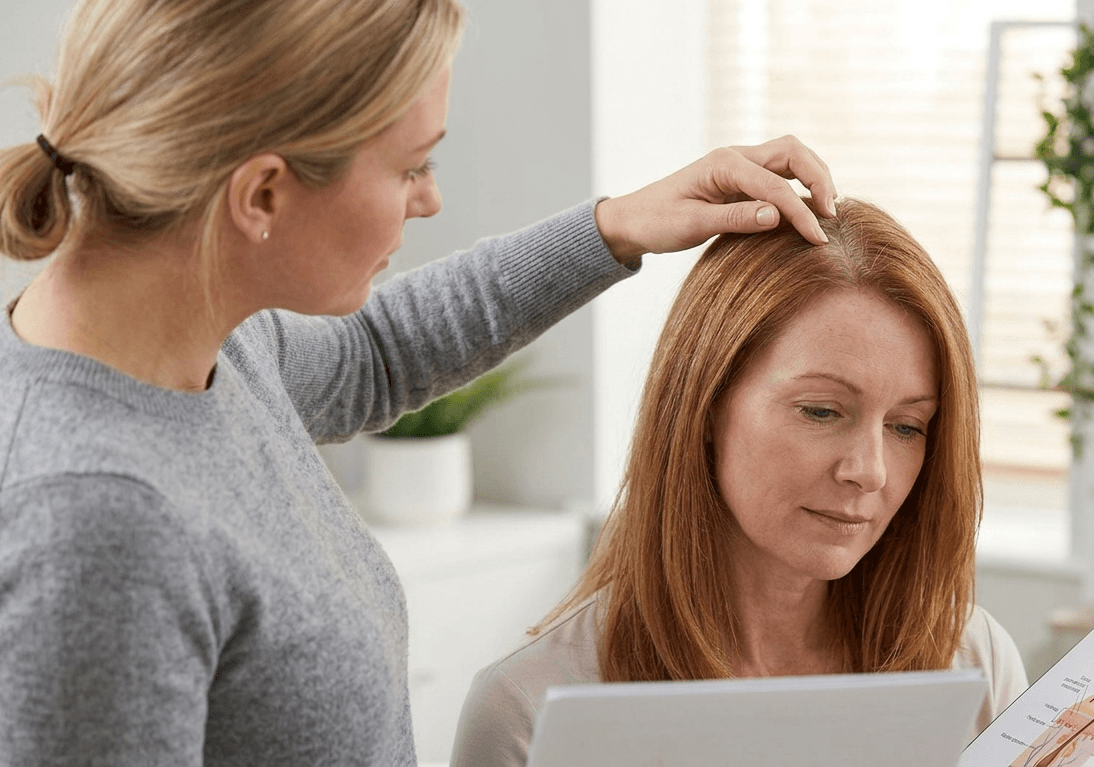
You should consider getting help if your hair thinning becomes rapid or patchy. It is also worth seeing a specialist if the thinning is accompanied by other symptoms such as irritation, excessive shedding, or visible scalp changes. While gradual thinning can be part of menopause, these patterns often suggest that something more than hormonal change may be involved.
One of the clearest signs is a noticeable increase in how much hair you are shedding in a short period. For example, if you begin to significantly lose more hair than usual, this may indicate a shift in your hair cycle that needs attention. Sudden shedding over weeks or a few months is not typically how menopause-related thinning presents on its own.
You should also pay attention to how your scalp looks and feels. Patchy areas, increased scalp visibility in specific spots, or any redness, itching, or discomfort are important signals. These are not usually associated with typical menopause hair thinning and may point to other conditions that require a different approach.
To make this clearer, here are some key signs that you should seek professional advice:
- Sudden, rapid shedding over weeks rather than gradual thinning over months
- Hair loss appearing in distinct or localised patches
- Scalp irritation, redness, or persistent itching
- Noticeable loss of volume that is affecting your confidence or mental well-being
There is also a “grey area” that is often overlooked. Even if your hair thinning is gradual, it may still be worth seeking advice if it feels noticeably different from your usual pattern. For example, your hair has always been thick, but you suddenly struggle to maintain volume. Another is when styling becomes more difficult than before. These changes are valid reasons to look deeper into what is happening.
Finally, your emotional response matters. If your hair thinning is affecting your confidence, causing stress, or making you feel less like yourself, that alone is enough reason to seek support. Getting help is not only about identifying a medical issue. It is also about gaining clarity, reassurance, and a clear plan so you are not left guessing what to do next.
Could Something Else Be Causing the Hair Thinning?
Not all hair thinning during menopause is caused by hormonal changes alone, as other conditions can contribute to or mimic similar symptoms. Assuming menopause is the only cause can delay the right kind of support and lead to frustration if the problem does not improve.
For example, iron deficiency is a common but often overlooked factor that can affect hair growth. When iron levels are low, the body prioritises essential functions over hair production. This may lead to increased shedding and reduced regrowth. Similarly, thyroid imbalances can influence hair texture, thickness, and growth patterns. Hair may become dry, brittle, or noticeably thinner, sometimes alongside other symptoms such as fatigue or changes in weight.
Stress can also play a significant role. A condition known as telogen effluvium can cause a large number of hairs to shift into the shedding phase at once. This leads to noticeable hair loss within a relatively short period. This type of shedding can feel sudden and alarming, especially when combined with the hormonal changes of menopause.
These factors can overlap with menopause-related thinning, making it difficult to distinguish between them without proper assessment. This is why it is important not to rely on assumptions. Identifying the underlying cause allows you to choose a more targeted and effective approach, rather than trying solutions that may not address the real issue.
How Long Does Menopause Hair Shedding Last?
This type of hair loss does not follow a single timeline. For some women, it may stabilise after the initial hormonal shift. For others, it can continue gradually over several years if the underlying factors are not addressed.
In many cases, the early stages involve increased shedding that eventually slows down. However, if the hair regrowth cycle has been affected, thinning may continue as new strands grow back finer or weaker. This is why some women feel that their hair never fully returns to how it was before menopause.
The duration also depends on whether other factors are involved. Nutritional deficiencies, stress, or underlying health conditions can prolong or worsen the thinning process. When these are identified and managed, it is often possible to improve both the condition of the hair and the rate of regrowth.
Understanding that menopause hair thinning is not always temporary helps you make more informed decisions. Rather than waiting to see if it resolves on its own, you can take steps to support your hair earlier and more effectively.

Can Menopause Hair Thinning Be Treated?
Menopause-related hair loss can often be managed and improved, especially when identified early and addressed with the right combination of treatments and lifestyle adjustments. While not every case can be fully reversed, many women are able to stabilise shedding and support healthier regrowth with the right approach.
A helpful way to think about treatment is in stages. The first step is identifying the cause. This may involve looking at hormonal changes, nutritional status, and any underlying health conditions. Without this step, it is difficult to choose the right direction.
Once the cause is clearer, the focus can shift to stabilising shedding. This may include using topical hair loss treatments, improving scalp health, or addressing internal factors such as deficiencies.
The final stage is supporting regrowth. This often takes time and consistency, as hair grows in cycles and does not respond instantly. You may begin to notice improvements in texture, strength, or density over several months rather than weeks. Setting realistic expectations is important, as it helps you stay consistent without becoming discouraged.
The most effective approach is always one that is tailored to your specific situation. Rather than trying multiple solutions at once, a structured and personalised plan allows you to track what is working and adjust where needed.
Why Waiting Too Long Can Make Hair Recovery More Difficult
Delaying action can allow hair thinning to progress, making it more difficult to restore density and regrowth over time. While menopause-related changes are often gradual, they can still lead to long-term effects if left unaddressed.
One of the key reasons for this is a process known as follicle miniaturisation. Over time, affected hair follicles can begin to produce thinner and weaker strands. Each growth cycle may result in hair that is slightly finer than before. Eventually, the hair becomes less visible or stops growing altogether. This process does not happen overnight. However, once it progresses, it can limit how much recovery is possible.
Early intervention does not mean reacting with urgency or concern at the first sign of change. Instead, it means recognising patterns early enough to respond effectively. When thinning is addressed sooner, there is often more potential to stabilise hair loss and improve overall density.
Furthermore, taking action early gives you more options and a better chance of maintaining your hair’s condition. It also helps you avoid the uncertainty that comes with waiting and hoping the problem resolves on its own.
How Do You Know What Kind of Help Is Right for You?
The right approach depends on the cause, pattern, and severity of your hair thinning. This is why personalised assessment is essential. Without understanding what is driving the change, it is easy to choose solutions that do not produce meaningful results.
A proper assessment often involves looking at your hair history, how quickly the thinning has developed, and whether there are any accompanying symptoms. In some cases, this may also include evaluating your scalp condition or identifying potential internal factors such as nutritional imbalances or hormonal changes. This process helps create a clearer picture of what is happening rather than relying on guesswork.
Trying to manage hair thinning without this clarity can lead to frustration. You may find yourself switching between products or approaches without seeing consistent improvement. In contrast, a structured plan based on accurate information allows you to move forward with confidence.
Seeking the right kind of help is not about overcomplicating the situation. It is about simplifying it. With the right guidance, you can focus on what actually works for your specific needs and avoid unnecessary trial and error.

In conclusion, menopause hair thinning is common. However, this does not mean it should be ignored. While many changes are part of the natural transition, there are clear signs that can indicate when support may be helpful.
Understanding what is normal and what is not allows you to respond with confidence. Instead of feeling uncertain, you can make informed decisions that protect your hair and your sense of control during this stage of life.
Are you unsure whether your menopause hair thinning is normal or a sign to get help? Speak directly with our trusted trichologist to get clear answers and a personalised plan based on what is actually happening. Call us on +353 (0)1 679 3618 or click here to book an online consultation.