Subtle changes in your hairline or overall thickness can be difficult to interpret, especially when they do not happen all at once. You might start questioning whether what you are seeing is normal, temporary, or the beginning of something more permanent.
In many cases, these early uncertainties are linked to DHT-related hair loss in men, the most common form of male pattern hair loss. Recognising how this condition typically presents can help you make sense of those small changes and understand whether they follow a known pattern.
What Is DHT-Related Hair Loss in Men?
This condition occurs when hair follicles become sensitive to a hormone called dihydrotestosterone, often shortened to DHT. This hormone is a natural by-product of testosterone and plays an important role in male development. However, in men who are genetically predisposed to hair loss, DHT can gradually shrink certain hair follicles on the scalp.
This type of hair loss is known medically as androgenetic alopecia or male pattern hair loss. As follicles become increasingly sensitive to DHT, they begin producing thinner and shorter strands of hair. Over time, the follicles gradually shrink, a process often referred to as follicle miniaturisation, which leads to progressively weaker hair growth.
What makes this process difficult to detect early is its gradual nature. Hair does not usually fall out in large patches. Instead, the hair slowly becomes less dense in specific areas of the scalp. Because the change happens slowly, many men only recognise the pattern after the thinning becomes more noticeable.
How Do You Know If DHT-Related Hair Loss Is Starting?
The early signs usually appear in predictable areas of the scalp. Most commonly, the temples and crown begin to show subtle thinning before other areas are affected. At first, the difference may only be visible in certain lighting or when the hair is wet.
One of the most recognised early changes is a receding hairline. The hairline may begin to move slightly higher at the temples, forming the familiar “M-shaped” pattern associated with male pattern hair loss. In other cases, thinning may start at the crown, where the scalp slowly becomes more visible through the hair.
Another common sign is a change in hair texture. Hair affected by follicle miniaturisation often becomes finer and softer than it once was. You may also notice that your hair does not grow as long as it used to, or that areas of the scalp appear less dense when styling your hair.
Because these changes often develop slowly, many men dismiss them as temporary shedding or normal ageing. Tracking subtle shifts over time can make it easier to recognise when thinning is becoming more consistent.
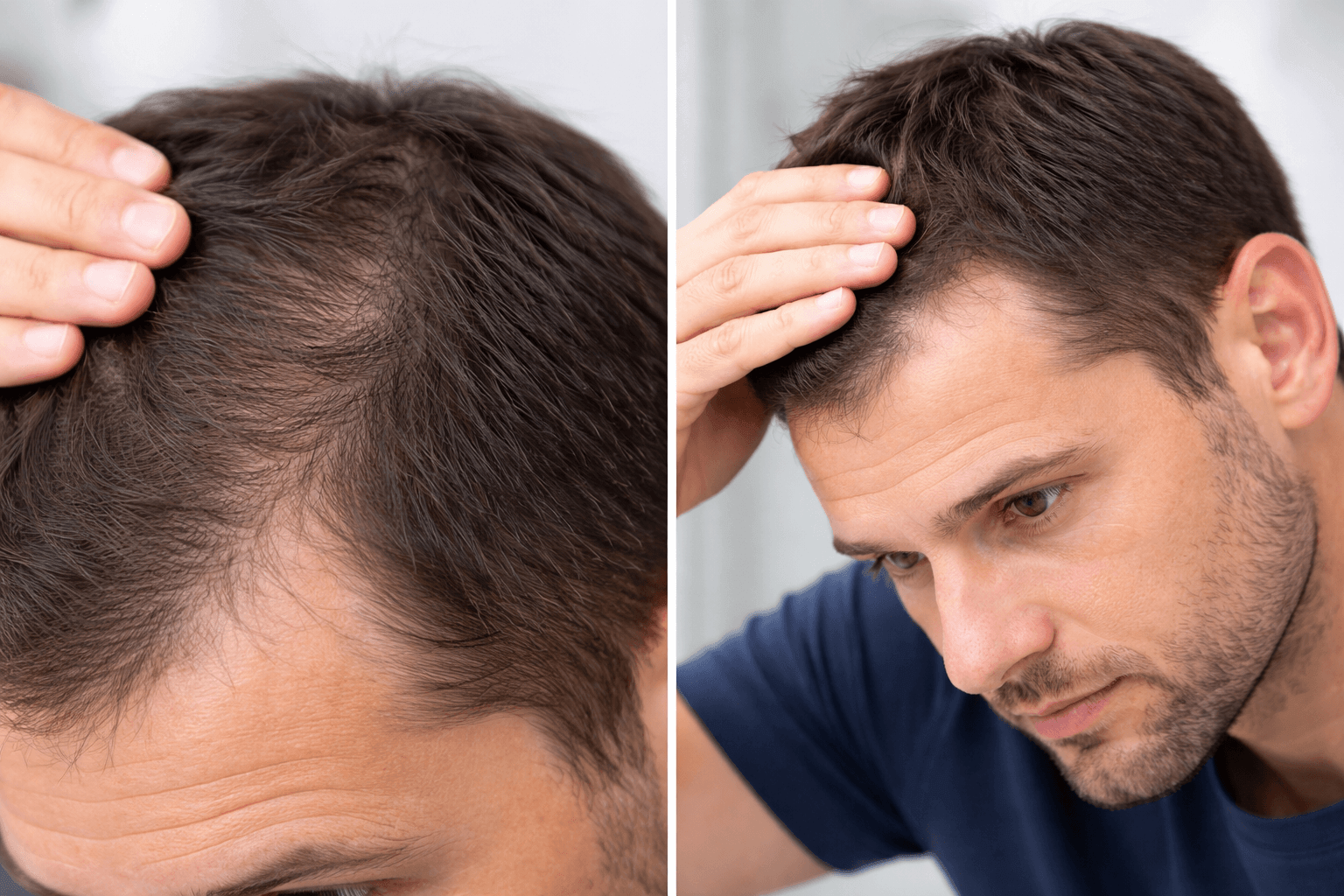
Why Does This Type of Hair Loss Begin at the Hairline and Crown?
Not all hair follicles respond to DHT in the same way. Certain follicles are genetically more sensitive to the hormone, particularly those located around the temples and crown. These areas are usually the first to show visible changes when DHT-related hair loss in men begins.
The follicles at the back and sides of the scalp tend to be more resistant to DHT. This difference in sensitivity explains the classic pattern of male pattern hair loss, where thinning occurs on the top of the scalp while the hair around the sides remains relatively stable. Even in advanced stages of hair loss, these resistant follicles often continue producing healthy hair.
This variation in follicle sensitivity also explains why hair loss tends to follow recognisable patterns. Over time, thinning at the hairline and crown may gradually spread across the top of the scalp. This creates the familiar progression associated with male pattern baldness.
Understanding this pattern can help you distinguish between general hair shedding and hormonal hair loss. When thinning repeatedly appears in these specific areas, it often points to a recognisable underlying cause.
How Quickly Does DHT-Related Hair Loss Progress?
The progression of DHT-related hair loss varies widely from person to person. Some men begin noticing changes in their early twenties, while others may not experience visible hair loss until later in life. Genetics often plays a major role in determining when and how quickly the condition progresses.
For many men, the process unfolds slowly over several years. The hairline may slowly move back, or the crown may become progressively thinner over time. Since the changes occur across multiple hair growth cycles, the pattern can take time to become obvious.
Hormonal factors and lifestyle influences may also affect how quickly hair loss becomes noticeable. Stress, illness, or nutritional deficiencies can sometimes influence hair shedding, although these factors usually affect overall hair health rather than directly causing androgenetic alopecia.
Because the process unfolds gradually, changes can be easy to overlook until the pattern becomes more noticeable. This is why some men only recognise the extent of hair loss after it has been developing for some time.

Can DHT-Related Hair Loss in Men Look Different for Each Person?
Although the condition follows a general pattern, it does not appear exactly the same for everyone. Some men primarily experience a receding hairline, while others first notice thinning at the crown. In some cases, the hair across the top of the scalp gradually becomes less dense rather than forming a clearly defined pattern.
Hair specialists often refer to the Norwood scale when describing the stages of male pattern hair loss. This scale illustrates how the condition may progress from mild recession at the temples to more advanced thinning across the crown and top of the scalp. However, not every man follows this progression in the same way.
Genetics can influence both the pattern and the rate of hair loss. Family history may offer some clues about how hair loss might develop, although it is not always a perfect predictor. Some men with strong family histories of hair loss experience early thinning, while others maintain thicker hair for longer.
Since the condition can appear differently from person to person, recognising subtle changes in your own hair pattern is often more useful than comparing your hairline with others.
When Should You Seek Professional Advice About DHT-Related Hair Loss?
If you notice persistent thinning at the temples or crown that continues over time, it may be helpful to seek professional advice. A hair loss specialist can examine the scalp and determine whether DHT-related hair loss is the likely cause of the changes you are seeing.
Additionally, hair loss can sometimes be confused with other scalp conditions. Temporary shedding related to stress, illness, or hormonal fluctuations can also cause noticeable hair thinning. A professional scalp assessment helps distinguish between these possibilities and provides clarity about what may be happening.
Early evaluation can be particularly valuable because it allows you to understand the stage and pattern of hair loss. Even when the changes appear mild, knowing the underlying cause can help guide decisions about how to manage hair health moving forward.

In conclusion, hair thinning rarely happens overnight. In most cases, DHT-related hair loss develops slowly as certain hair follicles become increasingly sensitive to the hormone DHT. Over time, these follicles produce finer strands of hair until the affected areas appear less dense.
Recognising early signs, such as a receding hairline or thinning at the crown, can help you understand whether the changes you are seeing follow the typical pattern of male pattern hair loss. While the process may develop at different speeds for different people, early awareness makes it easier to decide whether professional guidance could be helpful.
Are you noticing early signs of DHT-related hair loss in men and wondering what they mean? Let our hair specialist help you understand the condition and get the right treatment. Call us now on +353 (0)1 679 3618 to schedule a professional scalp assessment!